If you've ever called a spring manufacturer and struggled to explain exactly what you need, you're not alone. Most buyers know roughly what the part should do — hold a valve shut, pull a lever back, keep a hinge under tension — but not which spring family it belongs to. Getting this right before you order saves time, avoids a wrong-fit part, and gets your production line moving faster.
At S.K Products, we manufacture compression springs, tension springs and torque springs out of our unit in Ludhiana, so this is a question our customers ask us almost every week. Here's how to tell the three apart, and how to specify one correctly.
1. Compression Springs — built to push back against a load
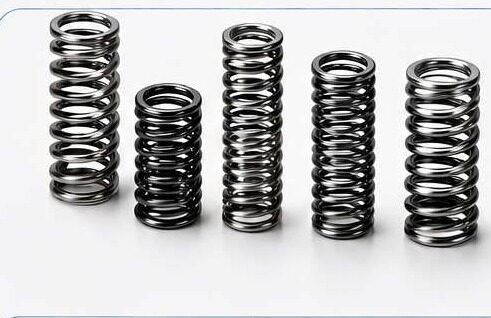
A compression spring is an open-coil spring designed to resist a force that's squeezing it shorter. As the coils compress, the spring pushes back — which is exactly what you want in mattresses, valves, shock absorbers, and countless industrial machines. Wound tightly with the coils separated slightly at rest, this spring type is used wherever a component needs to return to its extended position after being pressed.
Common applications: automotive suspension and valve assemblies, agricultural equipment, industrial machinery, electrical switchgear, and general-purpose mechanical assemblies that need excellent performance under heavy, repeated loads.
2. Tension Springs — built to pull two ends together
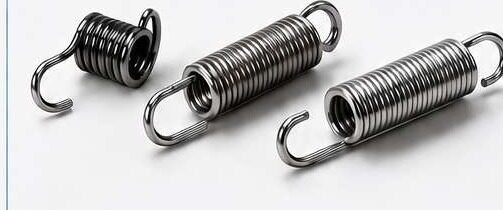
Tension springs — also called extension springs — do the opposite job. Their coils sit tightly wound against each other at rest, and the spring resists being stretched apart, pulling its two ends back together. You'll usually see hooks or loops formed at either end so the spring can be anchored to the parts it's connecting.
Common applications: trampolines, garage doors, agricultural implements, automotive clutch and brake linkages, and any assembly where two components need to be held together under a returning pull force. High tensile strength is critical here, since the spring is under constant stretching stress.
3. Torque Springs (Torsion Springs) — built to twist, not stretch
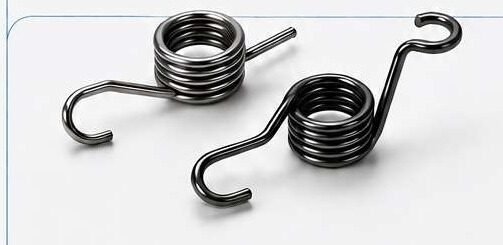
Torque springs, more commonly known as torsion springs, don't compress or stretch in a straight line — they store and release rotational (twisting) energy. The spring's legs or ends are mounted so that an applied force tries to rotate the coil, and the spring resists by exerting torque in the opposite direction.
Common applications: clothespins, garage door mechanisms, hinges, clipboards, and mechanical assemblies across industrial equipment where precision and durability under repeated twisting matter most.
A quick way to decide
- Does the part need to push apart / spring back after being squeezed? → Compression spring.
- Does the part need to pull two points together / stretch and snap back? → Tension spring.
- Does the part need to store energy in a twist / rotate back to position? → Torque (torsion) spring.
What to tell us when you call for a quote
Once you know the spring family, a few details make sure we manufacture it right the first time:
Wire Diameter
Thickness of the wire used to wind the spring.
Coil Diameter & Length
Outer/inner diameter, free length or number of coils.
Material
Spring steel, stainless steel, or another grade for your environment.
Load Requirement
How much force the spring needs to withstand or exert.